
Fatwa's Insights - Worship
Guidelines For The Implementation Of Worship For Persons With Disabilities (Pwd) In The State Of Perlis
THE 68TH MEETING OF THE PERLIS STATE FATWA COMMITTEE / 2024
5 - 6 JUN 2024 / 27 - 28 ZULKAEDAH 1445H
GUIDELINES FOR THE IMPLEMENTATION OF WORSHIP FOR PERSONS WITH DISABILITIES (PWD) IN THE STATE OF PERLIS
1. MUKALLAF / المكلف
A mukallaf individual is anyone who is of sound mind (capable of understanding the commands of Sharī'ah) and has reached puberty (bāligh).
2. WORSHIP FOR VISUALLY IMPAIRED (PWD)
2.1 Purification
2.1.1 Visually impaired PWD perform purification (ṭahārah) according to their ability.
2.1.2 Visually impaired PWD choose clothing that covers the 'awrah and is pure based on their capacity.
2.2 Prayer Times
Visually impaired PWD determine prayer times based on the call to prayer (adhān), or notification from a healthy person, or with the assistance of technology such as smartphones, or based on knowledge according to their ability.
2.3 Qiblah Direction
2.3.1 Visually impaired PWD determine the qiblah direction according to their ability by asking someone who knows or by detecting signs such as touching the miḥrāb, minbar, or the like.
2.3.2 Visually impaired PWD who mistakenly face the qiblah after making efforts to ascertain it are not obligated to repeat the prayer.
2.4 Prayer Imam
Visually impaired PWD may lead normal worshippers as imam in prayer.
2.5 Friday Prayer
Visually impaired PWD are obligated to perform Friday prayer if they are able to attend without any danger.
2.6 Fasting
2.6.1 The rulings on fasting for visually impaired PWD are the same as for normal persons, including matters relating to making up missed fasts and fidyah.
2.6.2 The time of imsāk (commencing the fast) and ifṭār (breaking the fast) should be based on reliable information.
2.7 Zakat
Visually impaired PWD are obliged to pay Zakat al‑Fiṭrah and other zakat if they meet the conditions for obligation. If they are unable to do so, their guardian or representative must pay it on their behalf.
2.8 Ḥajj
Visually impaired PWD are obligated to perform ḥajj if they have the capacity.
2.9 Other Issues
2.9.1 Awrāh
The rulings on awrāh for visually impaired PWD are the same as for normal persons, except in cases of necessity, extreme hardship, or unintentional exposure.
2.9.2 Touching
The rulings on touching what is forbidden for visually impaired PWD are the same as for normal persons, except in cases of necessity, extreme hardship, or unintentional contact.
3. WORSHIP FOR HEARING & SPEECH IMPAIRED PWD
3.1 Teaching the Shahādah Through Sign Language
Hearing & speech impaired PWD who can understand teaching or commands (comprehend khiṭāb) are mukallaf. They are obligated to recite the shahādah according to their ability, such as reading the written shahādah. If they are able to recite the shahādah using sign language, then hearing & speech impaired PWD are obligated to recite the shahādah with sign language.
3.2 Hearing Impaired PWD: Prayer
3.2.1 Hearing impaired PWD who can understand teaching and commands (comprehend khiṭāb) are obligated to learn prayer and perform prayer according to their ability.
3.2.2 Hearing impaired PWD who are able to speak or produce sound even slightly are obligated to articulate the verbal essential elements (arkān qawlī) according to their ability.
3.2.3 Hearing impaired PWD who absolutely cannot produce sound may move their tongue if they have the capacity to articulate the verbal essential elements or recite them internally.
3.3 Hearing Impaired PWD: Congregational Prayer
3.3.1 Hearing impaired PWD who serve as congregants may move their tongue if they have the capacity to articulate the verbal essential elements or recite them internally.
3.3.2 Hearing impaired PWD may lead prayer only among themselves.
3.3.3 Hearing impaired PWD who are mukallaf are obligated to attend and perform Friday prayer. They are also obligated to remain silent when the sermon (khuṭbah) is delivered and not engage in any matter that may disturb other congregants.
3.3.4 Hearing impaired PWD who are unable to control their voice to the extent of disturbing other congregants are not obligated to perform Friday prayer and should perform Ẓuhr prayer instead.
3.4 Worship for Speech Impaired PWD: Prayer
3.4.1 Mute Since Birth
There is no need to move the tongue to recite al-Fātiḥah and to articulate other verbal essential elements. It is sufficient to recite them internally.
3.4.2 Normal Person Becoming Mute
3.4.2.1 Obligated to move the tongue to recite al-Fātiḥah and articulate other verbal essential elements.
3.4.2.2 If unable to move the tongue, may transfer to internal recitation.
3.4.2.3 Speech impaired PWD who are able should move the tongue to articulate the verbal essential elements in prayer. If unable, it is sufficient to recite internally.
3.5 Ruling on Standing and Sitting for Final Tashahhud for Speech Impaired PWD
Speech impaired PWD who have no capacity to articulate verbal essential elements remain obligated to stand for the duration of reciting al-Fātiḥah and sit for the duration of reciting the final tashahhud.
3.6 Ruling on Speech Impaired PWD Serving as Imam
3.6.1 Speech impaired PWD may lead prayer for congregants similar to themselves or lesser than them.
3.6.2 Speech impaired PWD may not lead the prayer of normal persons.
3.7 Worship for Hearing & Speech Impaired PWD: Fasting, Zakāh & Ḥajj
Speech impaired PWD are obligated to perform fasting and zakāh in the same manner as other normal persons when conditions are met. They may also avail themselves of dispensations (rukhṣah) according to sharī'ah permission in the same manner as other normal persons. Likewise for ḥajj, it must be performed in the same manner as normal persons if they possess the capacity and have a companion.
4. WORSHIP ISSUES FOR PHYSICALLY DISABLED PWD
4.1 Purification
4.1.1 Physically disabled PWD are obligated to remove impurity (najāsah) from the body, clothing, and place of worship to perform prayer according to their ability.
4.1.2 Physically disabled PWD who face extraordinary difficulty in ensuring freedom from impurity on themselves, clothing, and place of worship are granted pardon to perform prayer in a state of impurity. Prayer performed in a state where the self, clothing, and place are impure is valid and does not require qaḍā'.
4.2 Ablution
4.2.1 Ablution for PWD who face the problem of continuous urine or faecal incontinence has the same ruling as one suffering from incontinence. Prayer performed in such state is valid and does not require qaḍā'.
4.2.2 Physically disabled PWD who have lost some ablution limbs are obligated to perform ablution on the remaining parts according to Allah SWT's command regarding ablution limbs based on their ability.
4.2.3 Physically disabled PWD who have lost all ablution limbs need not wash limbs that are not included among the ablution limbs.
4.3 Prayer
4.3.1 Physically disabled PWD are obligated to perform prayer according to their ability.
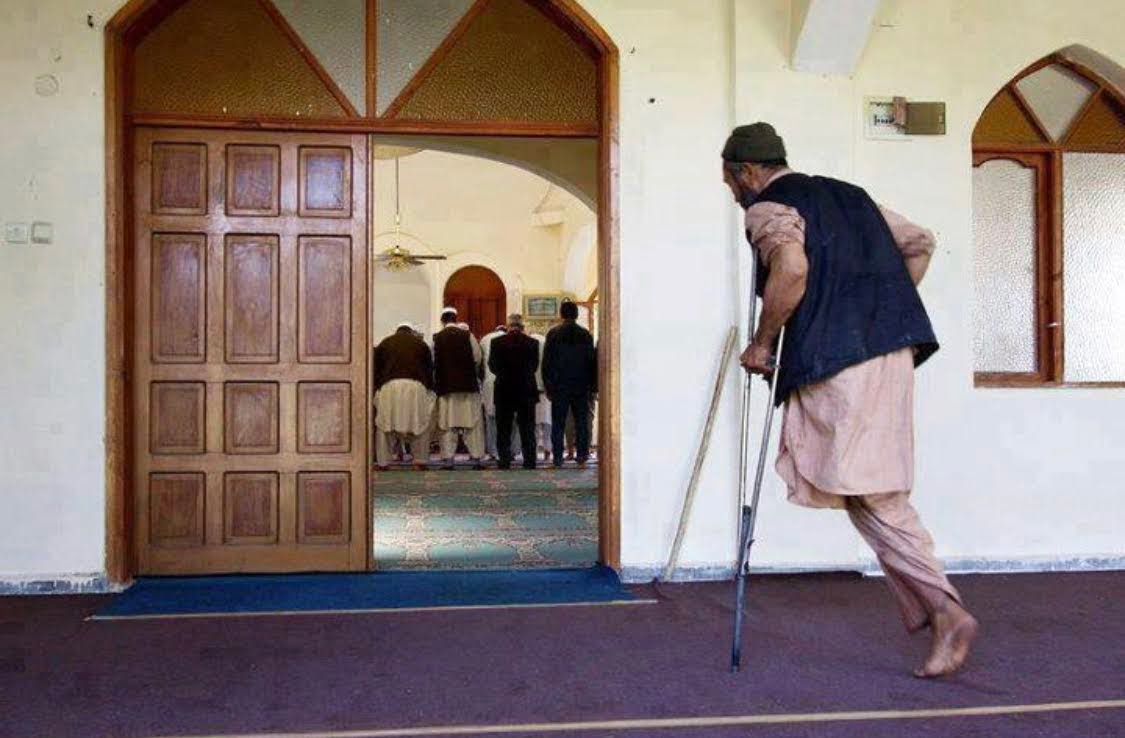
4.3.2 Physically disabled PWD who are able to stand are obligated to stand to perform obligatory prayer. If they are only able to stand momentarily, then they are obligated to stand for that duration, even if they must lean on a walking stick or wall.
4.3.3 Physically disabled PWD who cannot stand and depend on a wheelchair may perform prayer while seated on the wheelchair by making the prostration gesture lower than the bowing gesture.
4.3.4 A walking stick used in daily affairs may be used to support the body to perform prayer.
4.3.5 Walking sticks or wheelchairs to be used in the mosque must be ensured to be pure and clean to preserve the sanctity of the mosque and the rights of other congregants.
4.3.6 Wheelchairs, wheelchair wheels, walking sticks, and their lower parts are ruled pure as long as there is no definite impurity, even if they are used for daily affairs including touching the ground and roads in all conditions. If the presence of impurity is known after prayer, such prayer is valid and need not be performed as qaḍā'.
4.3.7 Impurity clearly visible on wheelchair wheels or underneath walking sticks may be removed by rubbing against the ground, with anything pure such as tissue, spray, or the like that can remove the substance of impurity ('ayn najāsah).
4.4 Prayer for PWD in Wheelchairs
PWD who are unable to sit on the floor may pray on a wheelchair or on a bed in a seated position by making prostration lower than bowing.
4.5 Prayer for Paralysed PWD
Paralysed PWD who are mukallaf are obligated to perform prayer according to their ability. Obligated to pray while seated if able, by making prostration lower than bowing. If unable while seated, may pray lying on the right side, distinguishing between the states of bowing and prostration according to ability.
If unable, may pray lying on the back by:
i. Lying on the back with both legs extended toward the qiblah.
ii. Intending the prayer to be performed and making takbīr while raising both hands if able.
iii. Recommended to recite the opening supplication (du'ā' iftitāḥ), then reciting the essential element al-Fātiḥah and recommended to recite a sūrah.
iv. Intending to perform bowing (rukū') while making takbīr along with raising hands if able. Reciting tasbīḥ during bowing.
v. Intending to perform i'tidāl while saying سمع الله لمن حمده along with raising hands if able.
vi. Intending to perform prostration (sujūd) while making takbīr, then reciting the prostration tasbīḥ.
vii. Intending while making takbīr to perform sitting between two prostrations and reciting the recitation when sitting between two prostrations.
viii. Continuing the prayer through gestures according to ability as explained until completion.
4.6 PWD with Parkinson's
Excessive and continuous bodily movements experienced by those with Parkinson’s disease or similar conditions, which they cannot control, are considered a valid excuse and do not invalidate the prayer. This is because every Sharī‘ah command is bound by the capacity of the individual.
ATTENDANCE AND APPROVAL BY:
1. Sahibus Samahah Professor Dato' Arif Perkasa Dr Mohd Asri Bin Zainul Abidin;
2. Sahibul Fadhilah Ustaz Tajul Urus bin Abdul Halim;
3. Sahibul Fadhilah Professor Dr. Muhamad Rozaimi bin Ramle;
4. Sahibul Fadhilah Professor Dr. Basri bin Ibrahim;
5. Sahibul Fadhilah Dr. Hj Zaharuddin bin Hj Abdul Rahman;
6. Sahibul Fadhilah Professor Dr. Azman Bin Mohd Noor;
7. Sahibul Fadhilah Associate Professor Dr. Mohd Akram bin Dato' Dahaman @ Dahlan;
8. Sahibul Fadhilah Dr. Ahmad Sufian bin Che Abdullah;
9. Sahibul Fadhilah Associate Professor Dr Ahmad Wifaq Bin Mokhtar;
10. Sahibul Fadhilah Ustaz Syed Abu Bakar bin Syed Kamal Bharin;
11. Sahibul Fadhilah Dr. Muhammad Lukman bin Mat Sin;
12. Sahibul Fadhilah Prof Madya Dr. Ismail Lutfi Japakiya al-Fatoni;
13. Sahibul Fadhilah Ustaz Aidil bin Abdul Rahman;
14. Al-Fadhil Ustaz Muhammad Khidhir bin Abdul Ghani – Secretary.